Complete Work Inventory

Projects with evidence, not just screenshots.

A comprehensive, engineering-level inventory of software systems, applications, and production web platforms—complete with live interfaces, technical rationale, constraints, and delivered outcomes.

Tier 1 — Flagship Systems

Multi-Application & Image Identification Architectures

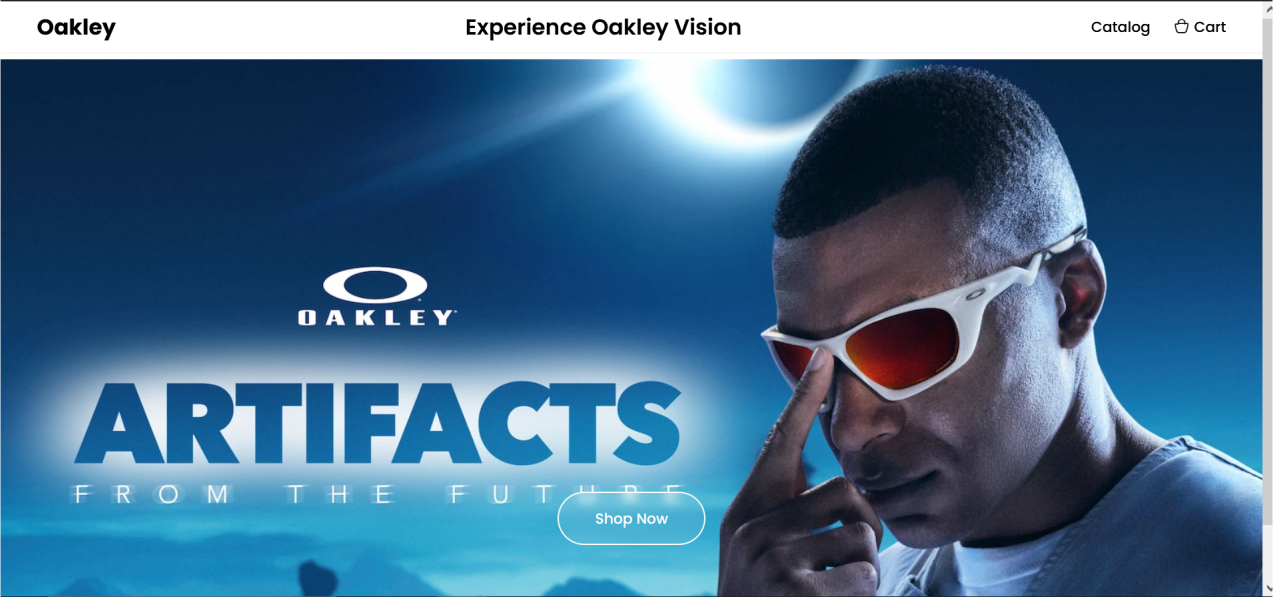
01 / Multi-application commerce system

Oakley Commerce Platform

Sole Developer & System Architect

A multi-app commerce platform separating the customer storefront SPA and vendor dashboard PWA, connected to a centralized Node.js/Express API and PostgreSQL with Row-Level Security.

Delivered Engineering Signal

Clear application boundaries, 3-dimensional state machines, database-enforced RLS policies, idempotent draft checkout, and automated end-to-end checkout testing.

Concrete Evidence & Decisions

  • Engineered separate customer storefront and vendor operations PWA connected to a single Express/TypeScript API.
  • Implemented 3-dimensional state machines governing order lifecycle, payment states, and system resolution.
  • Enforced multi-tenant isolation directly in PostgreSQL via database Row-Level Security (RLS) policies.
  • Developed automated end-to-end test harness validating stock reservation and checkout invariants.

Engineering Context

The system was architected to keep customer shopping and vendor administration cleanly separated while centralizing all critical commerce invariants—order state transitions, stock decrementing, payment proof uploads, and scheduled reconciliation—inside a single modular backend.

02 / Android image identification system

ObjectID

Primary Developer

A native Android image identification system combining custom touch bounding-box ROI annotation, quantized on-device MobileNetV3 TensorFlow Lite inference, and Imagga Cloud REST API fallback.

Delivered Engineering Signal

Pragmatic ML architectural pivot balancing on-device mobile hardware constraints with cloud API fallback, paired with robust memory management and defensive error pipelines.

Concrete Evidence & Decisions

  • Built touch-driven ROI annotation view enabling targeted object bounding box selection on Android Canvas.
  • Implemented dual-inference recognition pipeline combining on-device quantized TFLite and cloud Imagga API.
  • Designed defensive error handling with automated fallback from cloud API to local inference upon network timeout.
  • Structured with MVVM architecture, Kotlin Coroutines, OkHttp interceptors, and build-time secret isolation.

Engineering Context

The project required evaluating the gap between on-device ML compute limits and project delivery timelines. Rather than shipping an unfinished native C++/CMake stack with narrow class coverage, the architecture pivoted to a hybrid approach: cloud-first recognition for high precision with instant on-device TFLite fallback.

Tier 2 — Web Platforms & PWAs

Production Websites, Information Systems & Client Apps

Non-Profit Information Architecture

Al-Birr Charity Organization

Public Web Platform

Built a structured content hierarchy across programs, emergency aid, health outreach, and verifiable impact metrics. Designed clean presentation boundaries to protect vulnerable families in field documentation while optimizing donation conversion pathways.

Technical Highlights & Decisions

  • Modular domain structure separating program delivery, media verification, and donor conversion.
  • Privacy-aware presentation architecture for sensitive community field records.
  • Fast SSR execution and semantic markup optimized for organic outreach and low-bandwidth connections.

Community Impact Architecture

Pamoja Outreach Foundation

Public Web Platform

Designed and implemented a comprehensive information architecture spanning education programs, shelter initiatives, health camps, and volunteer ingestion, focused on responsive layout stability and zero layout shift.

Technical Highlights & Decisions

  • Custom responsive grid system handling high-density multimedia and long-form impact reporting.
  • Zero-dependency vanilla client implementation maximizing performance and load times on mobile devices.
  • Clear visual hierarchy directing visitors toward grassroots volunteering and sponsorship channels.
Acholi Women in Health Foundation
Live
Connecting to live system...
Open Live Project ↗
Stack:Next.js ·TypeScript ·Sanity CMS ·Neon PostgreSQL ·Prisma ·Cloudinary ·Resend

Healthcare Information System (In Active Use)

Acholi Women in Health Foundation

Live Production Platform

Live in active production with strict separation of responsibilities: Sanity CMS manages editorial website content, Neon PostgreSQL + Prisma stores operational mentorship applications, Cloudinary holds secure documents, and Resend handles transactional alerts.

Technical Highlights & Decisions

  • Live and in active use by the organization at acholiwomeninhealth.org.
  • Strict separation of concerns: Sanity (content) + Neon/Prisma (records) + Cloudinary (files) + Resend (email).
  • Prisma schema synchronization with automated pre-compile typechecks.
  • Accessibility-first component design supporting diverse regional bandwidth and screen constraints.

Interactive State-Driven Application

Valentine's Proposal (PWA)

Progressive Web App

Implemented a client-side state machine managing non-linear user decision branches, dynamic query parameter parsing for personalized URLs, and offline service worker caching for installable PWA behavior.

Technical Highlights & Decisions

  • State-driven interaction flow with deterministic branch transitions and responsive visual feedback.
  • URL-encoded parameter persistence enabling frictionless generation and sharing of personalized links.
  • Installable PWA manifest configuration with responsive audio/visual touch orchestration.